Group Travel Expense Splitting: Who Owes Whom, Without the Arguments
By the Brainfy Studio editorial team · Published
Splitting everything evenly is simple until one person skips the kayak trip or doesn't drink. The fair method is only slightly harder: for each expense, record who paid and who shared it. Each person's balance is what they paid minus their share, and the balances always add up to zero.
Free online tool: Travel Budget Calculator
Plan a trip budget by category and track what you've spent against it. Runs in your browser; no account needed.
Open the travel budget calculatorThe method
- List everyone on the trip.
- For every shared cost, record the amount, who paid and who shares it.
- Each sharer's share = amount ÷ number of sharers.
- Balance = total paid − total share. Positive means you are owed; negative means you owe.
- Settle: people who owe pay people who are owed until every balance is zero.
Agree the rules before you go
- Which costs are shared and which are personal.
- Whether people who skip an activity share its cost (usually not).
- One currency for the log, with foreign spending converted when it's entered.
- When you settle — at the end of the trip, or weekly on long trips.
- How you'll handle rounding (to the cent, or to the nearest dollar by agreement).
Tricky cases
Most disagreements come from a handful of situations. Decide them up front and log them the same way as any other expense.
| Situation | How to log it |
|---|---|
| Deposit paid months before the trip | Log it as a normal expense, paid by whoever paid the deposit, shared by everyone booked. |
| Refund received later | Log it as a negative expense, "paid" by whoever received the refund, shared by the same people as the original cost. |
| Someone arrives a day late | Leave them off the sharers for costs before they arrived (groceries, first night's dinner). |
| A couple wants to be treated as one | Either list them as one person and split their total between themselves, or list both — but agree which before the trip. |
| One card paid for everyone's tickets | One expense, paid by the cardholder, shared by everyone who received a ticket. |
Settling with as few payments as possible
Once the balances are known, the people who owe pay the people who are owed. Start with the largest debt and the largest credit, pay as much as possible between them, and repeat. A group of n people never needs more than n − 1 payments to settle, and often fewer — in the example below one person is owed everything, so three payments settle four people. Mark each payment as done in the log so nobody pays twice.
Worked example: four friends, one long weekend
Invented trip. Everyone shared everything except kayak hire, which three people did.
| Expense | Paid by | Amount | Shared by | Per person |
|---|---|---|---|---|
| Cabin, 3 nights | Priya | $1,320.00 | All 4 | $330.00 |
| Groceries | Marco | $212.40 | All 4 | $53.10 |
| Kayak hire | Lena | $180.00 | Priya, Marco, Lena | $60.00 |
| Fuel | Sam | $96.00 | All 4 | $24.00 |
| Dinner out | Priya | $254.80 | All 4 | $63.70 |
Totals: $2,063.20 spent. Fair shares: Priya, Marco and Lena $530.80 each; Sam $470.80 (no kayak).
Balances: Priya paid $1,574.80, so she is owed $1,044.00. Marco owes $318.40, Lena owes $350.80 and Sam owes $374.80. The three amounts owed add up to exactly $1,044.00, so three payments to Priya settle the whole trip.
Settle-up checklist
- Every receipt logged with payer and sharers.
- Foreign amounts converted to the trip currency.
- Balances add up to zero.
- Smallest set of payments agreed.
- Payments sent and marked as done.
Brainfy files for this task
Checked against the files customers download. Prices are current catalogue prices.
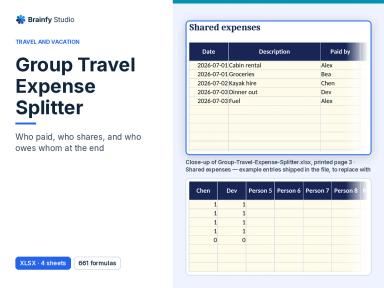
Group Travel Expense Splitter (Paid — $12.00)
XLSX · 1 file · sheets: Start Here, People, Expenses, Balances
Up to 10 people. Mark who shares each expense; the Balances sheet shows what each person paid, their fair share and whether they owe or are owed.
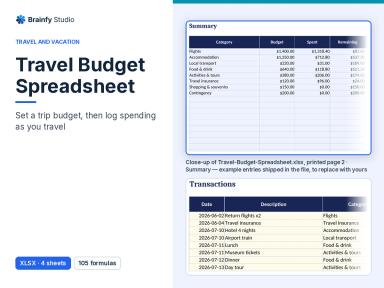
Travel Budget Spreadsheet (Paid — $12.00)
XLSX · 1 file · sheets: Start Here, Summary, Setup, Transactions
A trip budget by category with a spending log — for planning the total before you go.
Questions
What if someone pays in another currency?
Convert at the rate you agreed (or the rate on their card statement) when you log it, so all balances are in one currency.
Do the balances ever not add up to zero?
Only through rounding — a cent or two. Agree who absorbs it.
How many people does the spreadsheet handle?
Up to 10 people and up to 300 expense rows.
Sources and method
Arithmetic only; no external sources needed. The example balances are recomputed by an automated test. The 300-row limit is from the Expenses sheet (rows 4–303) in the v1.0.2 file.