Cash Flow Forecast Spreadsheet: Spot a Cash Gap Before It Happens
By the Brainfy Studio editorial team · Published
Profit and cash are not the same thing. A business can be profitable on paper and still miss payroll because customers pay in 45 days and suppliers want paying in 15. A cash flow forecast lists money in and money out by the week or month they actually happen, so you can see the gap before you reach it.
Free online tool: Cash Flow Planner
Forecast money in and out month by month and see when your balance would drop below a safety buffer. Runs in your browser; no account needed.
Open the cash flow plannerThe four inputs
- Opening balance — what is in the bank today.
- Receipts — when customers will actually pay, not when you invoice.
- Payments — payroll, suppliers, rent, loan repayments, tax instalments, owner drawings, in the week they leave the account.
- A minimum buffer — the lowest balance you are comfortable holding.
Weekly or monthly?
Use a 13-week (roughly one quarter) weekly forecast when cash is tight or payments are lumpy: it shows which week a problem lands in. Use a 12-month forecast for planning hires, purchases and seasonality. Many owners keep both and roll the weekly one forward every Monday, replacing last week's forecast with actuals.
When a week goes low
A low week is a prompt to act early, while there are still options.
- Chase or bring forward specific receipts (deposits, progress invoices).
- Move a discretionary payment to a later week.
- Talk to a supplier about terms before the due date.
- Arrange any financing you need before you need it, not during the low week.
Common forecasting mistakes
- Using invoice dates instead of the dates customers actually pay — check how late your slowest customers usually are.
- Forgetting irregular payments: annual insurance, quarterly tax instalments, equipment replacements, holiday pay.
- Leaving out owner drawings, so the forecast looks healthier than the account will be.
- Never replacing forecasts with actuals, so errors compound week after week.
- Treating the forecast as fact: add a note of the assumptions behind each large receipt so you can see which ones changed.
Worked example: six weeks for a small service business
Opening balance $12,500; minimum buffer $5,000. Receipts are when clients are expected to pay; payments include payroll in weeks 1 and 3.
| Week | Opening | Money in | Money out | Closing | Below $5,000? |
|---|---|---|---|---|---|
| 1 | $12,500 | $8,200 | $9,400 | $11,300 | No |
| 2 | $11,300 | $6,400 | $7,300 | $10,400 | No |
| 3 | $10,400 | $3,100 | $8,800 | $4,700 | Yes |
| 4 | $4,700 | $9,100 | $6,200 | $7,600 | No |
| 5 | $7,600 | $5,800 | $7,100 | $6,300 | No |
| 6 | $6,300 | $9,900 | $6,500 | $9,700 | No |
Week 3 closes at $4,700 — $300 under the buffer — because a large client payment lands in week 4. Seeing this in week 1 leaves time to ask for that payment a week early or move a supplier payment, instead of finding out from the bank.
Weekly forecast routine
- Update the opening balance from the bank.
- Replace last week's forecast figures with actuals.
- Re-date receipts that are now late.
- Add any new payments you have committed to.
- Roll the forecast forward one week.
- Act on any week below your buffer.
Brainfy files for this task
Checked against the files customers download. Prices are current catalogue prices.
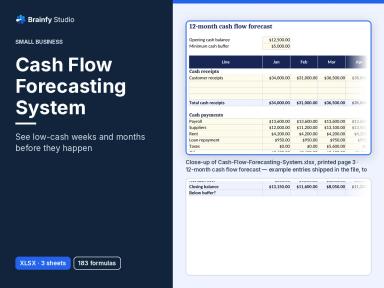
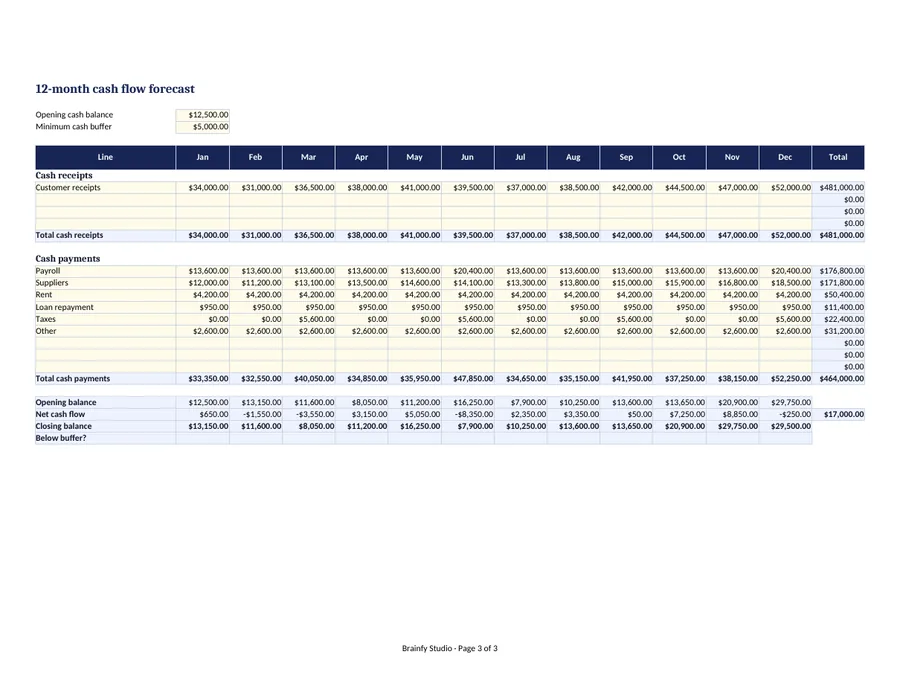
Cash Flow Forecasting System (Paid — $49.00)
XLSX · 1 file · sheets: Start Here, 13-Week Forecast, 12-Month Forecast
A 13-week and a 12-month forecast with opening and closing balances and a low-cash warning against your minimum buffer.
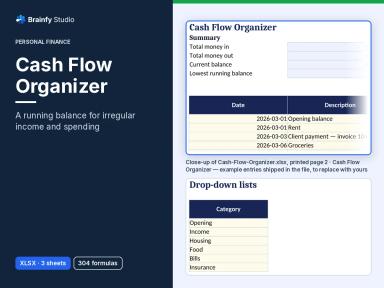
Cash Flow Organizer (Paid — $14.00)
XLSX · 1 file · sheets: Start Here, Cash Flow, Lists
Not a forecast: a dated ledger of money in and out with a running balance and lowest-balance figure, useful for irregular income.
Questions
Should I enter invoices or payments?
Payments — the date money actually reaches or leaves your account.
Does the forecast replace my accounting software?
No. Accounting records what happened; a forecast is your estimate of what will happen. Use both.
Which apps open the spreadsheets?
They are .xlsx files. They were recalculated in LibreOffice with no formula errors in our checks; Microsoft Excel and Google Sheets were not tested.
Sources and method
The forecast logic (closing = opening + money in − money out, flagged when below the buffer) is the same as the free Cash Flow Planner; the example's balances are recomputed by an automated test with that code.