Markup vs Margin for Contractors: Price a Job for the Profit You Want
By the Brainfy Studio editorial team · Published
Markup is what you add to your cost. Margin is the share of the selling price you keep. They use the same dollars but a different base, so the percentages never match — and pricing with one while thinking in the other quietly costs you money on every job.
Free online tool: Construction Estimate Calculator
Build a quick line-item construction estimate with material and labour unit costs, sales tax on materials, overhead, contingency and profit. Runs in your browser; no account needed.
Open the construction estimate calculatorAlso useful: Business Pricing Calculator, Job Costing Calculator
The two formulas
Markup is profit divided by cost. Margin is profit divided by price. Because the price is always bigger than the cost, the margin percentage is always smaller than the markup percentage for the same job.
- Price from a markup: price = cost × (1 + markup).
- Price from a target margin: price = cost ÷ (1 − margin).
- Markup → margin: margin = markup ÷ (1 + markup).
- Margin → markup: markup = margin ÷ (1 − margin).
Conversion table
Round numbers for the most common percentages. Use the formulas above for anything in between.
| Markup on cost | Margin on price |
|---|---|
| 10% | 9.09% |
| 15% | 13.04% |
| 20% | 16.67% |
| 25% | 20.00% |
| 33.33% | 25.00% |
| 50% | 33.33% |
| 100% | 50.00% |
Going the other way: a 10% margin needs an 11.11% markup, 20% needs 25%, 30% needs 42.86% and 40% needs 66.67%.
Where overhead fits
Contractors usually talk about overhead and profit ("O&P") together. Decide which one your percentages describe before comparing numbers. In the free construction estimate calculator and in both of our estimate spreadsheets, overhead is a percentage of direct cost and profit is a markup on direct cost plus overhead and contingency. The calculator reports two figures: the profit margin on price (profit ÷ total) and overhead plus profit as a share of the price.
Taxes are outside the margin
Margin is worked out on your selling price before any sales tax, GST/HST or VAT you collect on the invoice. Whether and how tax applies depends on where you work and the type of contract, so confirm it with your tax authority or a qualified professional rather than building a rule of thumb into your markup.
Which calculator uses which
| Tool | Percentage you enter | What it reports |
|---|---|---|
| Construction Estimate Calculator | Profit markup on cost | Profit margin on price, and overhead + profit as % of price |
| Business Pricing Calculator | Target profit margin on price | Hourly rate = cost per billable hour ÷ (1 − margin) |
| Job Costing Calculator | Nothing — it measures a finished job | Margin = gross profit ÷ (contract + change orders) |
Worked example: the same $1,000 two ways
A small repair has $1,000 of direct cost (materials, labour, subcontract — before tax).
| Approach | Calculation | Price | Profit | Margin on price |
|---|---|---|---|---|
| 25% markup | $1,000 × 1.25 | $1,250.00 | $250.00 | 20.00% |
| 25% target margin | $1,000 ÷ 0.75 | $1,333.33 | $333.33 | 25.00% |
To earn a 25% margin you need a 33.33% markup, not 25%.
On a bigger job the gap is real money. A kitchen with $48,000 of cost priced at a 20% markup sells for $57,600 and earns $9,600 — a 16.67% margin. If you meant a 20% margin, the price should have been $60,000 with $12,000 of profit: $2,400 left on the table.
Pricing checklist
- Write down whether your target is a markup or a margin.
- Convert it with the formula or the table before you enter it in an estimate tool.
- Check which percentage each tool expects (see the table above).
- Keep tax out of the margin calculation.
- After the job, compare the estimated margin with the actual margin from your job costing.
Brainfy files for this task
Checked against the files customers download. Prices are current catalogue prices.
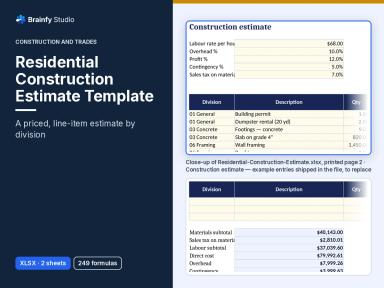
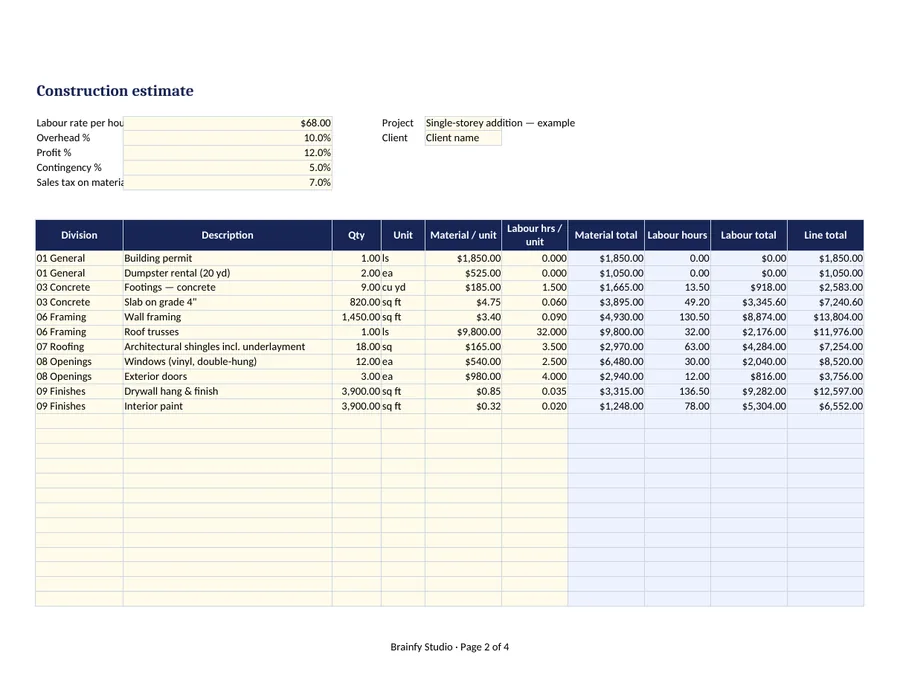
Residential Construction Estimate Template (Paid — $39.00)
XLSX · 1 file · sheets: Start Here, Estimate
Its Profit % input is a markup on direct cost plus overhead and contingency — enter the markup that gives the margin you want (see the table above).
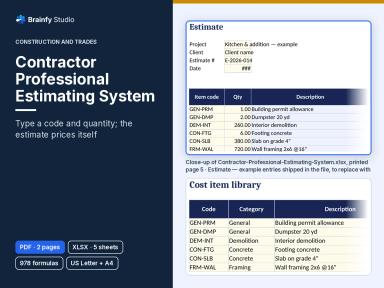
Contractor Professional Estimating System (Paid — $149.00)
PDF + XLSX · 3 files · sheets: Start Here, Company, Item Library, Estimate, Proposal
Uses the same markup method and also shows gross margin on price, which counts overhead and profit together.
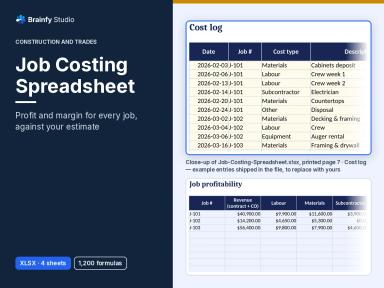
Job Costing Spreadsheet (Paid — $39.00)
XLSX · 1 file · sheets: Start Here, Job Summary, Jobs, Costs
After the job: margin per job is gross profit ÷ revenue (contract plus change orders), so you can see what you actually earned.
Questions
Is a 25% markup the same as a 25% margin?
No. A 25% markup gives a 20% margin. A 25% margin needs a 33.33% markup: $1,000 ÷ 0.75 = $1,333.33.
Can a margin be 100%?
No — that would mean zero cost. Margins approach but never reach 100%; markups can be any size.
Which one should I quote to a client?
Neither has to appear on a quote. Use them internally to set the price; clients see the price, any tax and your terms.
Sources and method
All percentages and amounts on this page are recomputed by an automated test using the same functions as the Brainfy calculators. No external data is used.