Seed Inventory for Garden Planning: Use Old Seed First, Buy Less
By the Brainfy Studio editorial team · Published
Most gardeners have a box of half-used packets and still buy the same seeds every spring. A short inventory — what you have, when it was packed and how long it is likely to stay good — tells you what to sow first and what you actually need to buy.
What to record per packet
- Crop and variety.
- Source (company, swap, saved).
- Year packed (from the packet).
- How many packets or roughly how many seeds.
- A typical viability in years — from the packet, your supplier or extension guidance.
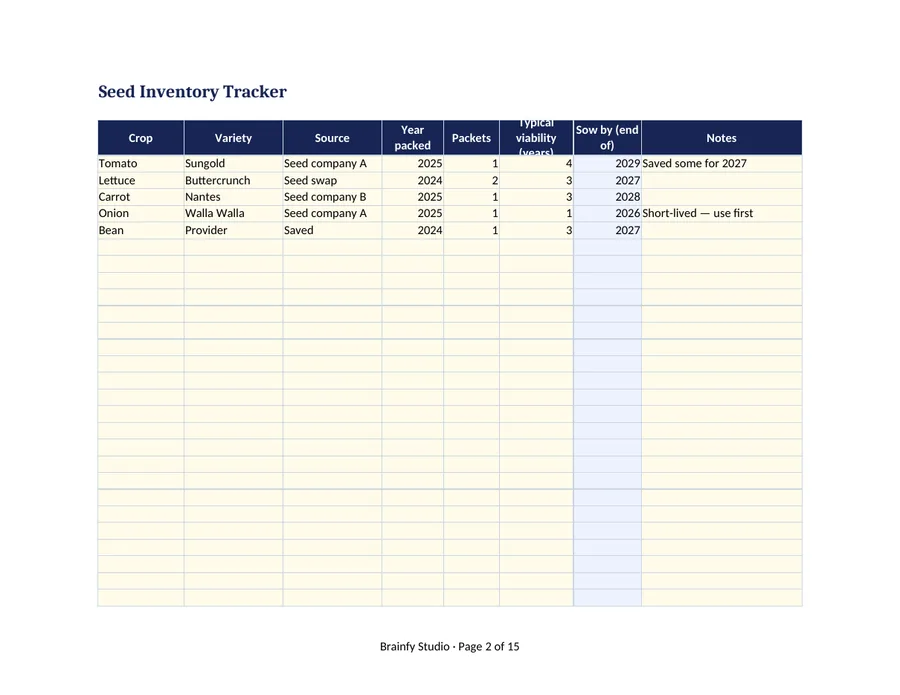
- Sow-by year = year packed + viability years.
Viability is a guide, not a date
How long seed stays viable depends on the crop and above all on storage: cool, dry conditions keep seed much longer. Extension services publish rough viability ranges and storage advice. Treat a past sow-by year as a reason to test the seed, not to throw it out.
Test before you trust old seed
A simple germination test: put a counted number of seeds (10 is easy) on a damp paper towel, keep it in a closed bag somewhere warm, and count how many sprout over the following days. The share that sprouts tells you how thickly to sow — or whether to buy fresh.
Connect it to your sowing dates
Once you know what you have, plan when to sow it. Many sowing calendars count weeks before or after your area's average last spring frost date; local extension services publish those dates.
Worked example: sorting four packets in spring 2026
Invented inventory; viability years are what each packet's supplier states.
| Crop | Year packed | Viability (yrs) | Sow by end of | Action in 2026 |
|---|---|---|---|---|
| Onion | 2025 | 1 | 2026 | Sow this season first |
| Tomato | 2023 | 4 | 2027 | Use; still in range |
| Lettuce | 2024 | 3 | 2027 | Use; still in range |
| Carrot | 2022 | 3 | 2025 | Past sow-by: germination test |
The carrot test: 7 of 10 seeds sprouted, a 70% germination rate. For about 30 plants, sow 30 ÷ 0.7 = 42.9, so 43 seeds.
Timing: with an average last frost date of May 10, 2026, starting tomatoes indoors 6 weeks before means March 29, 2026; transplanting 1 week after means May 17, 2026.
Pre-season checklist
- Every packet entered with year packed.
- Viability and sow-by year filled in.
- Packets past sow-by germination-tested.
- Shopping list made only for gaps.
- Sowing dates calculated from your local frost date.
- Seed stored cool and dry after sorting.
Brainfy files for this task
Checked against the files customers download. Prices are current catalogue prices.
Seed Inventory Tracker (Paid — $9.00)
XLSX · 1 file · sheets: Start Here, Seeds
One row per packet: crop, variety, source, year packed, packets and the viability you enter; it calculates the sow-by year.
Planting Schedule (Paid — $9.00)
XLSX · 1 file · sheets: Start Here, Schedule
Enter your average last spring frost date and week offsets; it calculates start-indoors, transplant and direct-sow dates.
Harvest Tracking Spreadsheet (Paid — $12.00)
XLSX · 1 file · sheets: Start Here, Harvests, Lists, By Crop
Log each harvest by bed and crop; totals by crop show which varieties earned their space.
Gardening Expense Planner (Paid — $9.00)
XLSX · 1 file · sheets: Start Here, Summary, Setup, Transactions
A season budget by category with a purchase log.
Questions
How long do seeds last?
It varies by crop and storage. Use the packet or your supplier's figure, check extension guidance for your crops, and test anything you're unsure of.
Where do I find my last frost date?
From your local agricultural extension service, gardening club or national weather service.
Does the planting schedule include my local dates?
No. You enter your own average last frost date and can adjust each crop's week offsets.
Sources and method
The sow-by rule (year packed + viability years) and the frost-date arithmetic (frost date + weeks × 7 days) are the formulas used in the Seed Inventory Tracker and Planting Schedule. The example inventory is invented and recomputed by an automated test.
- Storing Vegetable and Flower Seeds — Colorado State University Extension
- Are my seeds still good? Testing seed germination — University of Illinois Extension