Family Emergency Binder Checklist: What to Include and Where to Keep It
By the Brainfy Studio editorial team · Published
In an emergency nobody wants to search for a phone number. A family emergency binder keeps the essentials — who to call, where to meet, how to shut off the water — in one place that a babysitter, grandparent or neighbour can use without asking you.
What to include
| Section | What goes in it |
|---|---|
| Household | Address and nearest cross-street, home and mobile numbers, a neighbour's number |
| Family members | Each person's name, date of birth, allergies and conditions their doctor has recorded, doctor's name |
| Contacts | Local contacts and one out-of-area contact everyone can reach |
| Meeting places | One near home and one outside the neighbourhood |
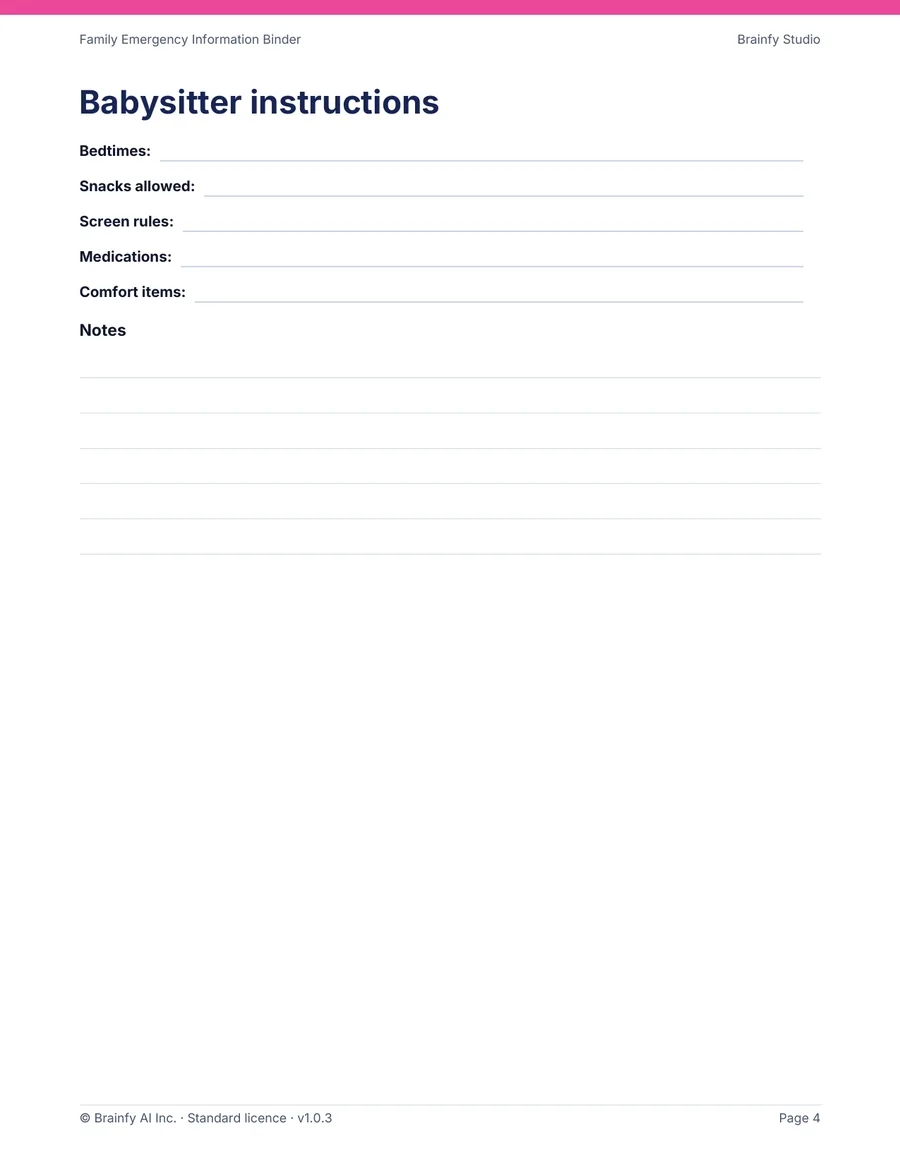
| Babysitter page | Bedtimes, food rules, comfort items, any prescribed medication instructions copied from the label |
| Utilities | Where the water shut-off, electrical panel, gas shut-off, fire extinguisher and first-aid kit are |
| Documents | Where insurance and ID documents are kept (locations, not originals) |
Plan for being apart
Emergency planning guidance from public agencies stresses that families may not be together when something happens: agree how you will contact each other, name an out-of-area contact, and pick meeting places near home and further away. Write those decisions on the plan page so a babysitter or visitor knows them too.
Where to keep it
Somewhere everyone in the house knows and a visitor can find quickly — near the main phone, the fridge or the front door. Give a copy to your out-of-area contact. Because it holds personal details, don't leave it where strangers see it.
Walk through it with the people who'll use it
A binder only helps if the person holding it knows what's in it. Spend five minutes showing a new babysitter or visiting relative the contact page, the meeting places and where the shut-offs are — and physically point to the water shut-off and the electrical panel. Children old enough to use a phone can learn the out-of-area contact's number and the meeting places.
Keep it current
- Change a phone number in the binder the day it changes.
- Re-check allergies, doctors and schools at every review.
- Replace wallet cards when any number on them changes.
- Re-walk the utility shut-offs after any renovation or move.
- Write the date of the last review on the cover.
Worked example: copies and reviews for a family of four
Invented example for a household of two adults and two children.
| Item | Count / date |
|---|---|
| Wallet cards (one per person) | 4 |
| Binder copies: home, car, out-of-area relative | 3 |
| First set-up | 2026-11-08 |
| Review every 6 months — next review | 2027-05-08 |
Put the next review date on the binder's cover and in a phone calendar. Update immediately when a number, school, doctor or medication changes, not only at review time.
Emergency binder checklist
- Household page with address and nearest cross-street.
- Every family member's details, allergies and doctor.
- Local and out-of-area contacts.
- Two meeting places agreed.
- Babysitter instructions written.
- Utility shut-off locations checked in person.
- Wallet cards cut out and carried.
- Copies given to the out-of-area contact.
- Next review date set.
Brainfy files for this task
Checked against the files customers download. Prices are current catalogue prices.
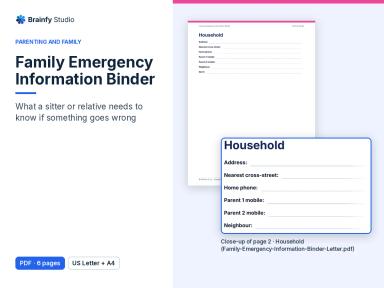
Family Emergency Information Binder (Paid — $19.00)
PDF · 2 files · US Letter and A4 · 6 pages per file
Household information, family members with allergies/conditions and doctors, babysitter instructions, emergency plan with meeting points, and utility shut-off locations.
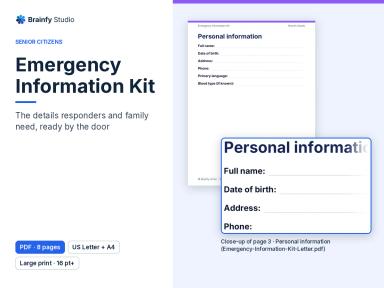
Emergency Information Kit (Paid — $14.00)
PDF · 2 files · US Letter and A4 · 8 pages per file
For one person: personal information, emergency contacts, healthcare contacts, allergies and conditions, home and utilities, and a cut-out wallet card.
Questions
Is this the same as an emergency kit?
No. A kit is supplies (water, food, torch); the binder is information. Public preparedness guides recommend both.
Should medical details go in it?
Record what has been prescribed or diagnosed by a doctor and copy medication instructions from the label. The binder is for information, not medical decisions.
Can I fill it in on a computer?
The binder and kit are printable PDFs without fillable fields; print them and write in them.
Sources and method
Organisational guidance only. The planning points (out-of-area contact, two meeting places, regular review) follow the public guidance listed. The review interval in the example is our illustration; the date arithmetic is checked by an automated test. We checked that the two PDFs have no fillable form fields.
- Make a Plan — Ready.gov (US FEMA)
- Make an Emergency Plan — Government of Canada
- Make an Emergency and Disaster Plan — Canadian Red Cross