How to Organize a Caregiver Binder: Sections, Order and Who Updates What
By the Brainfy Studio editorial team · Published
When several people help care for someone, information ends up in text threads, on fridge notes and in one person's head. A caregiver binder puts it in one place, in the same order every time, so whoever is helping today can find the doctor's number, this week's schedule or the last appointment's follow-up in seconds. It is an organiser — not a medical record and not medical advice.
Sections, in a useful order
Put what a stand-in helper needs first at the front.
- Profile: name, date of birth, language, allergies and the conditions their doctors have recorded, communication needs.
- Care team: family, doctors, pharmacist, home care, neighbours — with phone numbers and what each one does.
- Weekly schedule: who covers which part of each day.
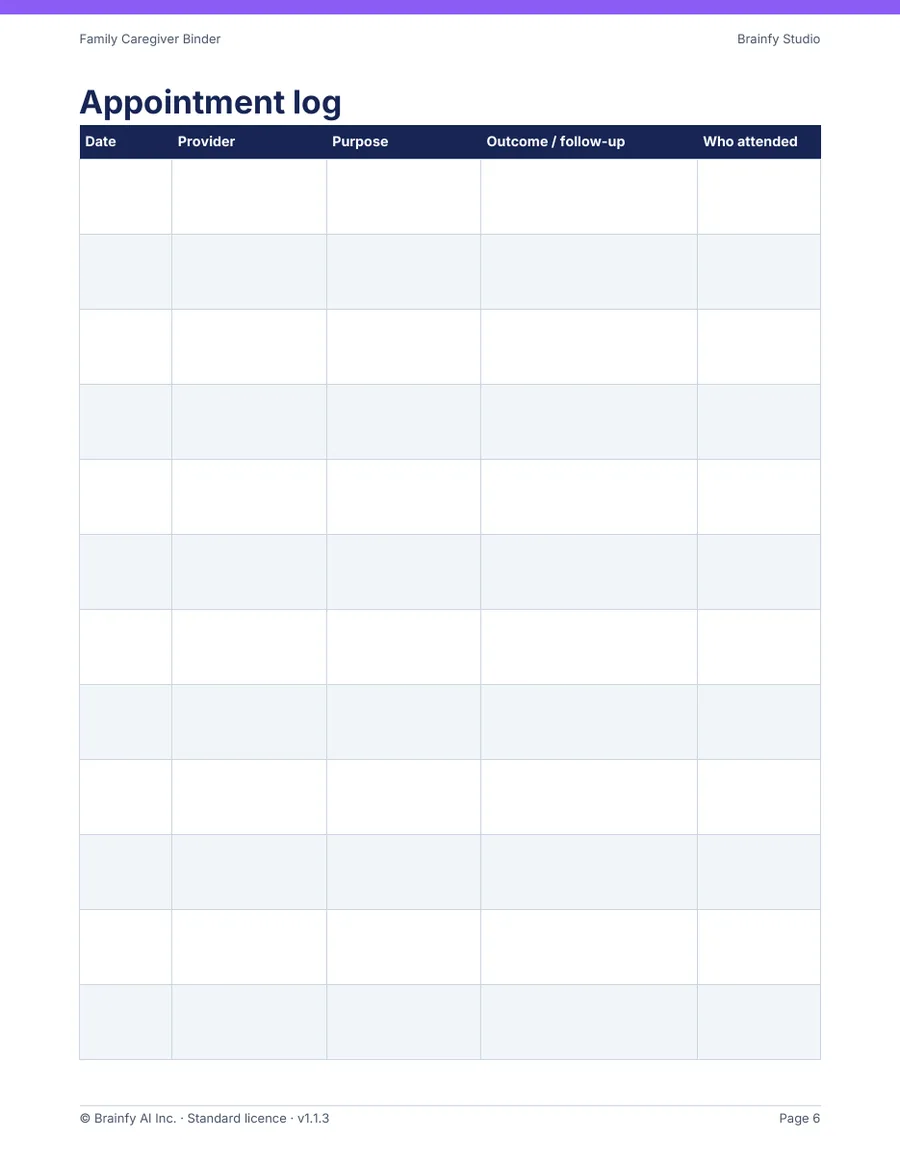
- Appointments: date, provider, purpose, outcome and follow-up.
- Medication list: copied exactly from the prescription label or pharmacist — never changed on your own.
- Daily notes: meals, activity, mood, concerns, who was there.
- Expenses: what was paid, by whom, receipt kept or not.
- Documents locator: where the will, powers of attorney, insurance and ID are kept — not the documents themselves.
Decide who updates what
A binder goes stale when everyone assumes someone else updates it. Give each section an owner: one person for the medication list (updated only from the pharmacy label or the prescriber), one for appointments, one for expenses. Everyone writes daily notes.
Take it to appointments
Bring the profile, medication list and appointment log. Write questions down before the visit and the answers during it. If the person you care for agrees, ask their providers what permission they need to speak with you.
Keep sensitive information safe
The binder holds personal and health information. Keep it somewhere private, share copies only with people who need them, and list where important documents are kept rather than putting originals in the binder.
Worked example: covering a week between three helpers
Invented example: the family wants someone present twice a day — 14 visits a week. Two siblings and a home-care agency share them, and they split shared care costs by an agreed percentage.
| Who | Visits per week |
|---|---|
| Sibling A | 5 |
| Sibling B | 4 |
| Home-care agency | 3 |
| Covered | 12 |
| Gap to fill | 2 |
The schedule shows the 2 uncovered visits before the week starts, so they can be filled by a neighbour or an extra agency visit. Shared costs for the month were $640, split 50/30/20 as agreed: $320, $192 and $128 — recorded on the expenses page with who paid what.
Set-up checklist
- Profile page filled in with the person you care for, if they can take part.
- Care team list with every phone number checked.
- An owner named for each section.
- Medication list copied from current labels, dated.
- Weekly schedule with gaps visible.
- Documents locator completed (locations only).
- Binder kept in an agreed, private place.
- Review date set (for example monthly).
Brainfy files for this task
Checked against the files customers download. Prices are current catalogue prices.
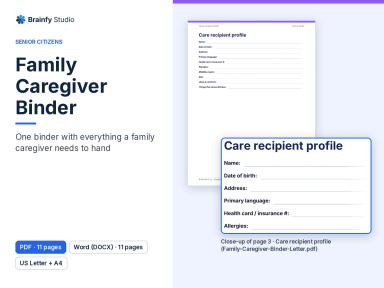
Family Caregiver Binder (Paid — $39.00)
DOCX + PDF · 4 files · US Letter and A4 · 11 pages per file
Care recipient profile, care team, weekly care schedule, appointment log, medication list (copied as prescribed), daily care notes, expenses, important documents locator and a page for the caregiver. Editable Word version included.
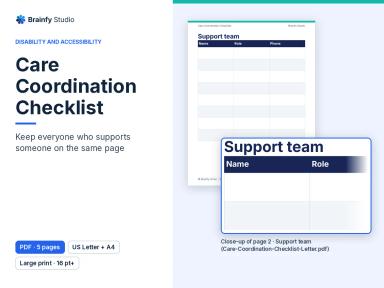
Care Coordination Checklist (Paid — $12.00)
PDF · 2 files · US Letter and A4 · 5 pages per file
Support team directory, coordination checklist, weekly support schedule and handover notes.
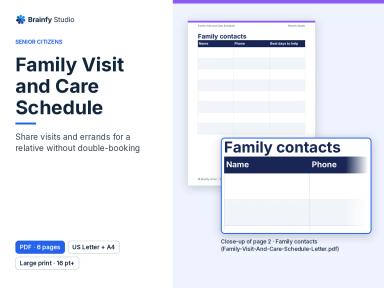
Family Visit and Care Schedule (Paid — $14.00)
PDF · 2 files · US Letter and A4 · 6 pages per file
For siblings and relatives sharing visits and errands: contacts, weekly visit schedule, errands rota, visit log and a monthly calendar.
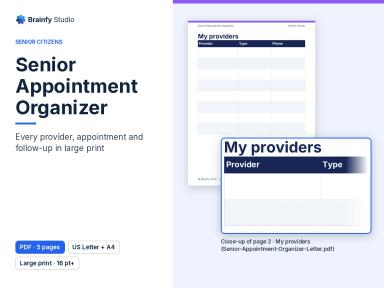
Senior Appointment Organizer (Paid — $14.00)
PDF · 2 files · US Letter and A4 · 5 pages per file
Providers, appointments, questions to ask before a visit and what was said after it.
Questions
Can the binder tell me what medication to give?
No. It records what has been prescribed, copied from the label or pharmacist. Questions about medicines or doses go to the prescriber or pharmacist.
Paper or digital?
Either. The binder comes as a printable PDF and an editable Word file in US Letter and A4; many families keep paper at home and a photo of key pages on their phones.
What about legal documents like power of attorney?
The binder only records where such documents are kept. Whether you need them and how to make them depends on where you live — ask a lawyer or the relevant public body.
Sources and method
Organisational guidance only; no clinical content. Section order is our own, informed by the NIA worksheets and checklists listed (keeping papers in one known place, sharing access with a trusted person). The example is invented and its arithmetic checked by an automated test.
- Caregiver Worksheets — National Institute on Aging (US)
- Getting Your Affairs in Order Checklist — National Institute on Aging (US)
- Getting Started With Caregiving — National Institute on Aging (US)