A reorder point is the stock level at which you place the next order, so the new delivery arrives before the shelf is empty. It comes from three numbers you can find for every product: how many you sell a day, how many days the supplier takes to deliver, and a small cushion of safety stock for busier-than-usual days and late deliveries.
On this page
The three numbers you need
- Average daily sales: units sold over a recent period divided by the days in it. Ninety days smooths out a single busy weekend; use a shorter window for a new product.
- Lead time: days from placing an order to having the stock ready to sell, including the supplier's processing, shipping and your own unpacking and listing time.
- Safety stock: extra units held for demand above average or a delivery that runs late.
The reorder point formula
Reorder point = average daily sales × lead time in days + safety stock.
The first part is the stock you expect to sell while you wait for the delivery. The safety stock is what stops a slightly busier week, or a delivery two days late, from becoming an empty shelf. When stock on hand plus anything already on order falls to the reorder point, it is time to order.
Two ways to size safety stock
The simplest method is days of cover: hold, say, five days of average sales as a cushion. It is easy to explain and fine for steady sellers.
A more precise method uses how much daily sales vary. Safety stock = service factor × standard deviation of daily sales × √lead time. The service factor comes from the share of order cycles you want to get through without running out: about 1.28 for 90%, 1.65 for 95% and 2.33 for 99%. Higher service levels need much more stock for each extra point, so keep the highest levels for best sellers and items customers can't wait for.
How much to order
The reorder point says when; the order quantity says how much. A common starting point is enough stock to cover a set number of days of sales, such as 30, rounded up to the supplier's case pack and to at least their minimum order quantity. Larger orders mean fewer deliveries but more money tied up on the shelf, so compare the order value with your cash plan before you place it.
Keep the inputs honest
The formula is only as good as the stock count. Log deliveries, sales, returns and write-offs as they happen, count a few items every week (a cycle count) rather than everything once a year, and recalculate reorder points after a season changes demand. A product that sells twice as fast in December needs a December reorder point.
- Record lead times from real deliveries, not the supplier's best case.
- Separate made-to-order items: they need production time, not stock.
- Flag slow movers with no sales in 90 days before reordering them.
Spreadsheets that do the arithmetic
The Inventory and Reorder Point Tracker gives every item a reorder point from its last 90 days of sales, the supplier's lead time and a safety stock sized to a service level you choose (90% to 99%), then suggests an order rounded up to the case pack and the supplier's minimum, with a reorder list per supplier. It comes as worked-example and blank workbooks with a 7-page PDF guide in US Letter and A4.
For the wider shop, the Online Seller Operations System covers channel fees, products and unit costs, stock with reorder flags, orders, listings and a monthly profit and loss; the Small Shop Order Fulfillment Tracker handles ship-by dates and packing; and the Online Shop Fee and Profit Calculator compares platform fees on the same product.
Worked example: a best-selling candle
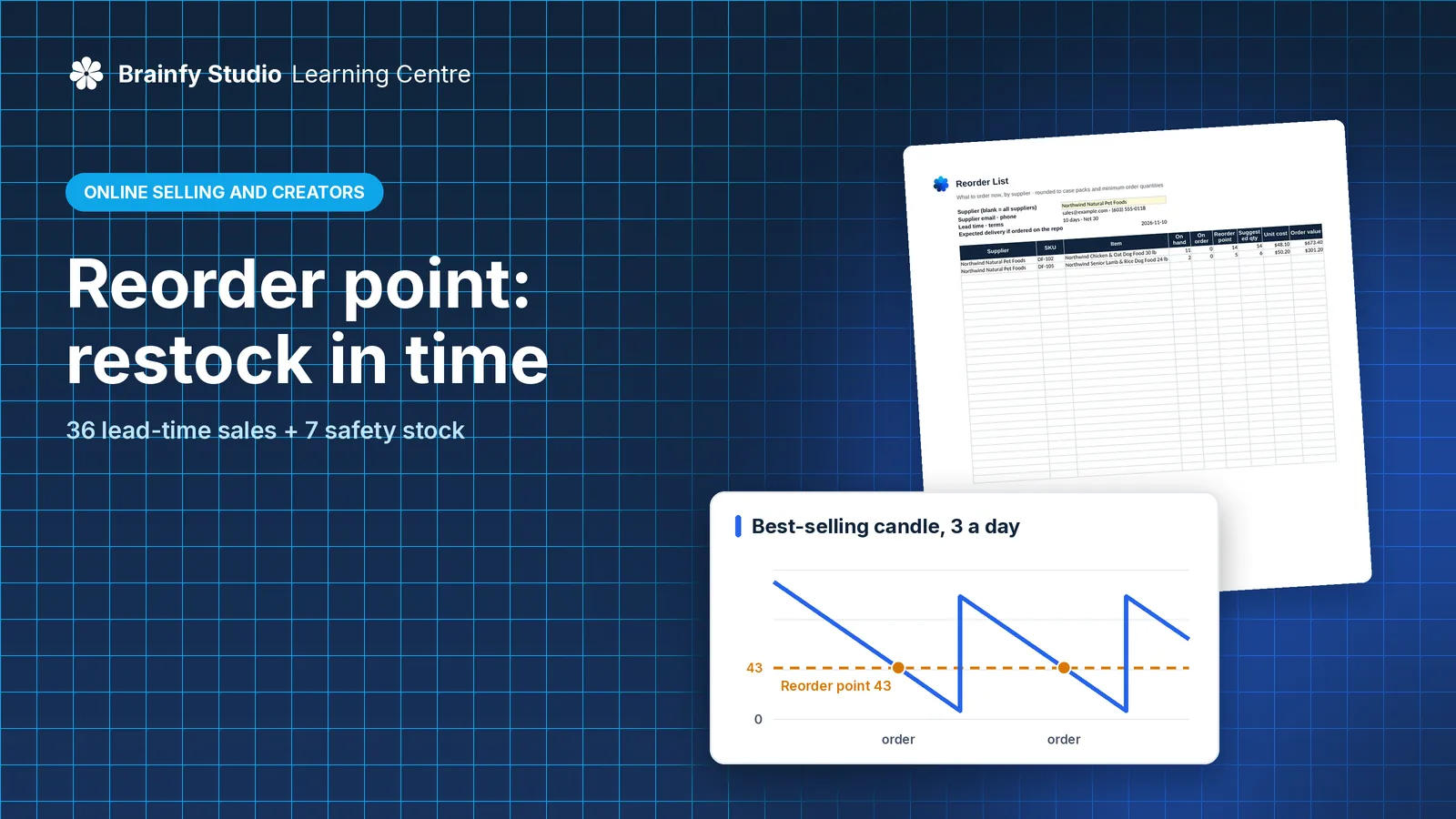
A fictional shop sold 270 of its best-selling candle in the last 90 days. The supplier takes 12 days from order to ready-to-sell stock, daily sales vary with a standard deviation of 1.2 candles, and the shop wants a 95% service level. Candles come in cases of 24, with a minimum order of 48.
| Step | How it is calculated | Result |
|---|---|---|
| Average daily sales | 270 ÷ 90 days | 3 |
| Sales during lead time | 3 × 12 days | 36 |
| Safety stock | 1.65 × 1.2 × √12 = 6.86, rounded up | 7 |
| Reorder point | 36 + 7 | 43 |
| 30 days of sales | 3 × 30 | 90 |
| Order quantity | 90 rounded up to cases of 24 (at least 48) | 96 |
When stock on hand plus stock on order falls to 43 candles, the shop orders 96 (four cases). With the simpler days-of-cover method, five days of safety stock would be 15 candles and a reorder point of 51: more stock held, but easier to explain.
Before you set reorder points
- Stock counts are up to date and match the shelf.
- Daily sales come from a recent, representative period.
- Lead times come from real deliveries.
- Safety stock is higher for best sellers than for slow lines.
- Order quantities respect case packs and supplier minimums.
- The order value fits your cash plan.
Questions
What is a good service level for a small shop?
There is no single right figure. Many small shops use around 95% for best sellers and lower for slow or easily substituted items. Higher levels need more stock and more cash.
Should stock already on order count?
Yes. Compare the reorder point with stock on hand plus open orders, or you will order twice for the same gap.
Do I need a reorder point for made-to-order products?
Not for the finished product. Use reorder points for the materials and packaging instead, and plan production time separately.
Is this accounting advice?
No. It is general information to help you manage stock. For tax and accounting treatment of inventory, ask a qualified professional.
Sources and method
Product facts were read from each product's live page on 16 November 2026. Every number in the worked example is recomputed by an automated test.