Kindergarten readiness is less about reading early and more about being comfortable in a classroom: following a short routine, holding a pencil and scissors, recognising some letters and numbers, and asking for help. A checklist helps you notice what your child can already do, and short, playful practice covers the rest without turning the year before school into homework.
On this page
What readiness usually covers
Schools and early years programmes describe readiness in slightly different words, but most checklists group the same five areas. Use them as a way of noticing, not as a test your child has to pass before the first day.
- Self-care and routines: using the toilet, washing hands, putting on a coat and shoes, opening a lunch box, following a two- or three-step instruction.
- Fine motor skills: holding a crayon or pencil, drawing lines and simple shapes, using child-safe scissors, gluing, building with small pieces.
- Early literacy: enjoying stories, recognising their own name, knowing some letter names and sounds, hearing the first sound of a word.
- Early numeracy: counting objects one by one, recognising small numbers, comparing more and fewer, spotting simple patterns and shapes.
- Social and emotional skills: taking turns, sharing attention, waiting a short time, naming a feeling, asking an adult for help.
Age cut-off dates and what a school expects in the first weeks vary by province, state and school board, so check your local school's own information pack. If something on the list worries you, ask the school or your child's doctor rather than practising harder at home.
Practise little and often
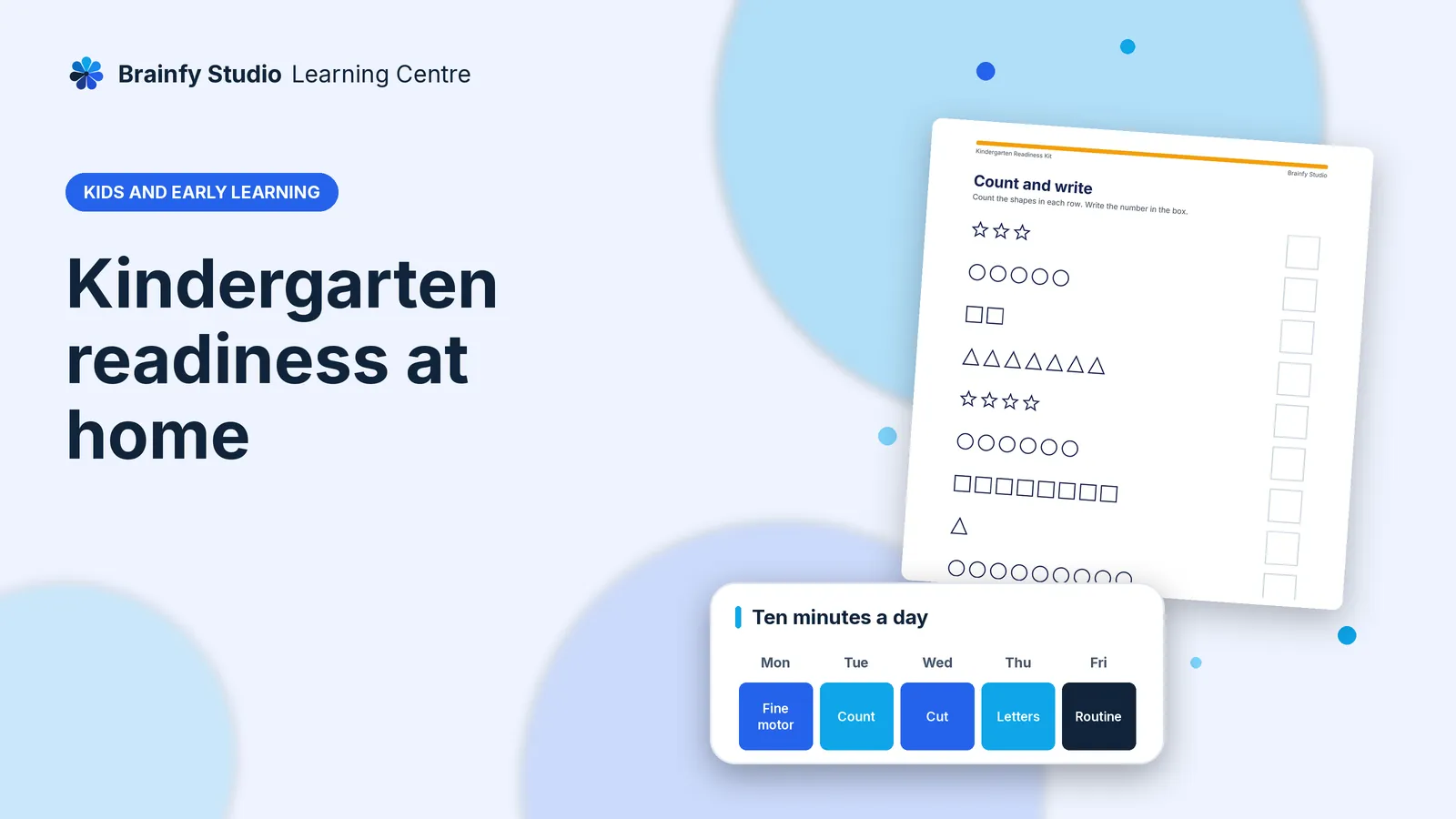
Young children concentrate best in short bursts. Ten minutes at the kitchen table, at a time of day when your child is fed and rested, does more than a long session at the weekend. Stop while it is still fun, and keep the rest of the day for play, outdoor time and reading together.
Rotate the five areas through the week so nothing becomes a chore, and repeat the same kind of activity for a few days before moving on. Repetition is how a new movement or sound becomes easy.
- Sit side by side and do the first line together before your child tries one alone.
- Praise effort and strategy ("you went slowly round the curve") rather than neatness.
- Use real objects for counting first, then pictures, then numerals on the page.
- Read aloud every day; it does more for early literacy than any worksheet.
Pencil and scissor skills come before letters
Letter formation is easier once a child can draw straight lines, zigzags, curves and loops with control, because every letter is built from those strokes. Prewriting paths with wide practice spaces let children work on the movement before worrying about the letter itself.
Scissor practice follows the same order: single snips, then straight lines, then zigzags, curves and shapes. Always use child-safe scissors with an adult nearby, and expect the first attempts to be wobbly.
Routines make the first weeks easier
Children who know what happens next feel more confident. A simple picture routine for the morning, after school and bedtime gives the same sense of order a classroom timetable will, and a First / Then board ("first shoes, then park") helps with transitions that cause friction.
In the last few weeks before school starts, practise the real morning: getting dressed, eating breakfast and leaving at the time you will need to on school days.
Printable packs for each area
If you would like structured pages, these Brainfy Studio packs each cover one area, with an adult guide and US Letter and A4 editions. The Kindergarten Readiness Kit is a 17-page overview with a skills checklist for grown-ups, tracing, letters, counting to 10, shapes, patterns, sorting, cutting practice, a routine chart, a reading log and a 30-day activity calendar.
For more practice in one area: Pencil Control and Prewriting Paths has 44 practice pages in six levels; Cut and Paste Scissor Skills has 39 practice pages ending in 8 cut and paste pictures, plus adult safety pages; Alphabet and Letter Sounds has 70 activity pages teaching the 26 letters in seven sets; Numbers 0 to 20 Tracing and Counting has 60 learner pages in three levels. Visual Daily Routine Cards cover the routines section. Two free samples, an alphabet sample and a counting sample, let you check the print size and style first.
Worked example: one week of ten-minute sessions
A fictional four-year-old practises on five weekday mornings, one area per day, with a story at bedtime every day. The weekend is for play and outings.
| Day | Area | Activity | Minutes |
|---|---|---|---|
| Monday | Fine motor | Two prewriting paths: straight lines, then zigzags | 10 |
| Tuesday | Early numeracy | Count spoons into cups, then one counting page | 10 |
| Wednesday | Fine motor | Snip paper strips, then cut one straight line | 10 |
| Thursday | Early literacy | Find the letters of their name on a letter hunt page | 10 |
| Friday | Routines | Practise the morning picture routine at school-day pace | 10 |
| Total | Five sessions | 50 |
That is 50 minutes of table practice across the week, about the length of one episode of a children's programme, plus a daily story. If a session stops being fun after five minutes, stop at five.
Before the first day
- You have read the school's own information pack and know the start time, drop-off routine and what to bring.
- Your child can say their full name and recognise it written down.
- Coat, shoes, lunch box and water bottle are ones your child can manage alone.
- You have practised the morning routine at school-day times at least a few times.
- Any concerns about speech, hearing, vision, movement or behaviour have been raised with the school or a doctor.
Questions
Does my child need to read before kindergarten?
Usually not. Most kindergarten programmes teach reading from the start. Enjoying stories, recognising their name and knowing some letters is a good foundation.
How long should practice sessions be?
About ten minutes for three- and four-year-olds, a little longer at five if your child is keen. Short and regular beats long and occasional.
Which pack should I start with?
Try the free alphabet and counting samples to check the style and print size. The Kindergarten Readiness Kit covers every area in 17 pages; the single-area workbooks give more pages for one skill.
Are the packs a readiness assessment?
No. The checklist in the kit is for grown-ups to notice and plan practice. It is not a developmental assessment or a substitute for advice from your child's school or doctor.
Sources and method
Product facts (page counts, levels and editions) were read from each product's live page on 16 November 2026. The weekly minutes in the example are added up by an automated test.