A weekly lesson plan works best when it is cut from a unit plan, not written from scratch every Sunday night. Start from what students should know or do by the end of the unit, split that into lessons, and give each lesson one clear objective, a way of checking it was met, and timings that fit the period you actually have.
On this page
Start from the unit, then the week
Your curriculum or programme of study sets the outcomes; the unit plan decides the order you teach them in. List the lessons of the unit, mark any assessments, and note the days you will lose to assemblies, trips or holidays. The week's plan then becomes a matter of picking up the next lessons in the sequence.
Keep the school calendar next to the unit plan so short weeks are visible before you start, not on the Thursday you run out of days.
One objective and its success criteria
Write each lesson's objective as something students will be able to do, in words you could say to the class: "Find equivalent fractions using a fraction wall." Then add two or three success criteria that describe what doing it well looks like. Students can use them to check their own work, and you can use them to decide what to reteach.
Plan the lesson in timed parts
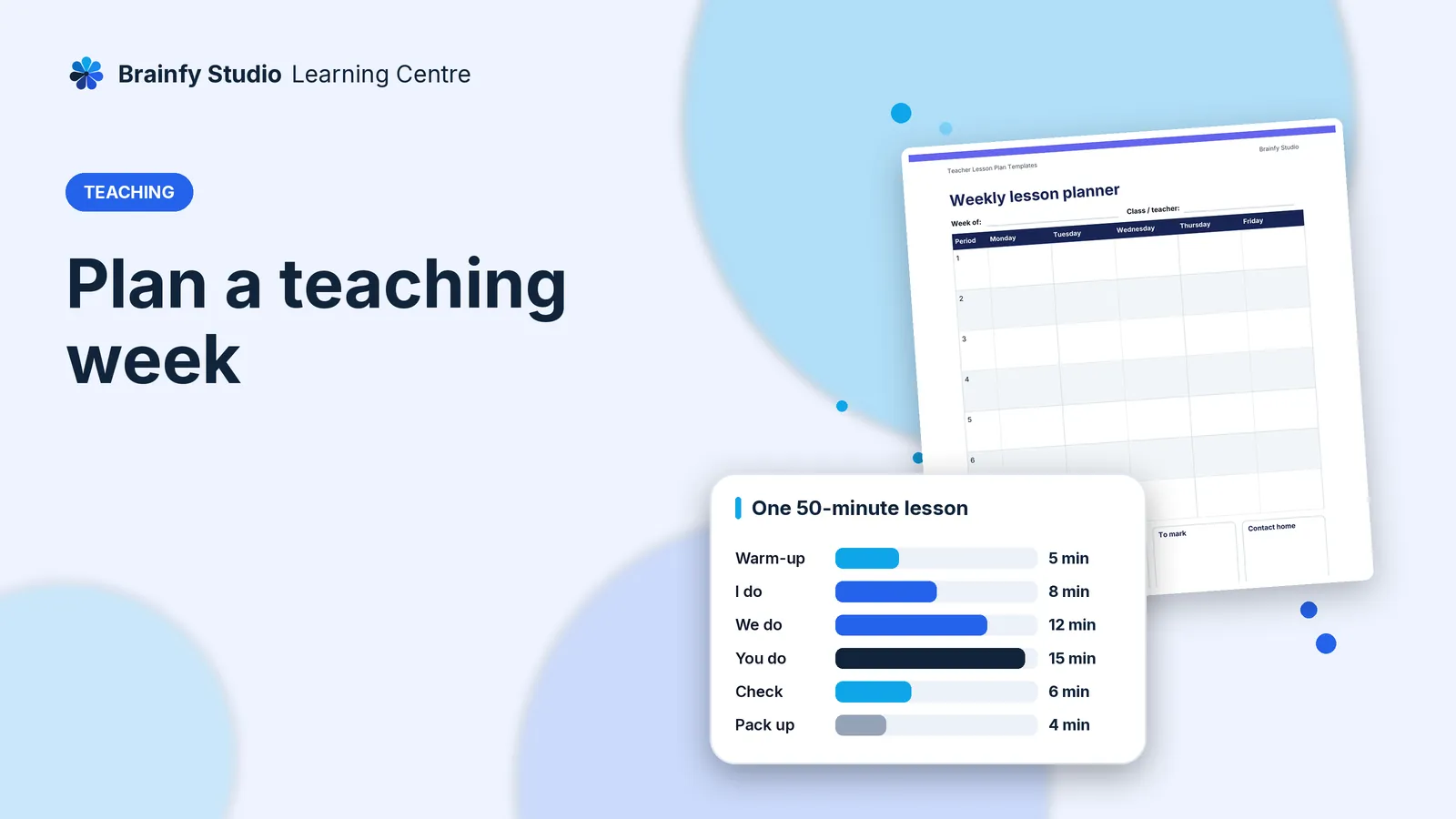
A simple and widely used structure is a short warm-up, a modelled example (I do), guided practice together (we do), independent practice (you do), and a quick check before the end. Put minutes next to each part and make sure they add up to the period. If they add up to more, cut something now rather than rushing the end of the lesson.
- Warm-up: retrieval of something taught last week, or a problem that leads into today's idea.
- I do: one or two worked examples, thinking aloud.
- We do: the class tries similar examples with support; you watch for misconceptions.
- You do: independent practice, with an extension task ready.
- Check: an exit ticket of two or three questions that matches the success criteria.
Differentiation and checks for understanding
Note in the plan what support you will offer (a worked example on the table, sentence starters, manipulatives) and what stretch looks like for students who finish early. Planning it ahead means you are not inventing it mid-lesson.
Record exit-ticket results somewhere you will look again. A gradebook with weighted assessments or a simple tally by success criterion shows which students need the idea again tomorrow and which ideas need reteaching to everyone.
Leave a plan someone else can teach
Every week, keep one substitute plan up to date: the class list, seating, routines, where materials are, a self-contained lesson that does not depend on the last one, and who to ask for help. On the morning you are ill it is the most valuable page in the planner.
Templates that follow this method
Brainfy Studio's Teacher Lesson Plan Templates are 8 pages in Word and PDF, in US Letter and A4: a daily plan with objective, success criteria and I do / we do / you do, a differentiation, assessment and reflection page, a worked Grade 4 equivalent fractions example, a weekly planner, a 10-lesson unit plan and a substitute teacher plan.
The Teacher Weekly Organizer is a printable week at a glance by period, with to-do and marking, duties and meetings, a parent contact log, student notes, substitute notes and a week review. For records, the Student Assessment Tracker is a weighted gradebook for 40 students and 10 assessments, and the free Class Roster Template holds a class list of up to 40 students with a checklist grid and a groups page.
Worked example: a 50-minute lesson that fits its period
A fictional Grade 4 class has 50-minute maths periods. The objective is "Find equivalent fractions using a fraction wall", with two success criteria: shade two fractions that cover the same length, and write the pair as an equation.
| Part | What happens | Minutes |
|---|---|---|
| Warm-up | Three retrieval questions on halves and quarters | 5 |
| I do | Model 1/2 = 2/4 = 4/8 on the fraction wall, thinking aloud | 8 |
| We do | Pairs find two more equivalent pairs; teacher circulates | 12 |
| You do | Six questions, with an extension on thirds and sixths | 15 |
| Check | Exit ticket: two questions matching the success criteria | 6 |
| Pack up | Tidy fraction walls, preview tomorrow | 4 |
| Total | 50 |
The parts add up to exactly 50 minutes. If the warm-up regularly runs to 10 minutes, the plan shows that the 5 minutes have to come out of independent practice, which is usually the part that matters most.
Before the week starts
- Each lesson has one objective written as something students will do.
- Each objective has two or three success criteria.
- Lesson timings add up to the period length.
- Support and extension are written down, not improvised.
- Exit-ticket results have a place to be recorded.
- The substitute plan is current and in an obvious place.
Questions
Do the templates follow a particular curriculum?
No. They are planning layouts. Your district, state or provincial curriculum sets the outcomes; you write those into the plan.
Can I edit the lesson plan templates?
Yes. They come as Word documents (DOCX) as well as PDF, in US Letter and A4. Page counts are as laid out in LibreOffice; Word or Google Docs may differ by a page.
How detailed should a weekly plan be?
Detailed enough that the timing and the check for understanding are clear. A full script is rarely needed except for a substitute plan.
Is there a free download?
Yes: the Class Roster Template is free with an account. The lesson plan templates and weekly organizer are paid.
Sources and method
Product facts were read from each product's live page on 16 November 2026. The lesson minutes in the example are added up by an automated test.