A contractor proposal is the document your client reads, accepts and signs before work starts. It should state, in plain words, seven things: the scope of work, what is excluded, any allowances, the price and payment schedule, the timeline, how changes are handled, and how the client accepts. This guide explains each part and then shows a complete worked proposal for a small deck job, with units and arithmetic you can check.
On this page
Free online tool: Construction Estimate Calculator
Build a quick line-item construction estimate with material and labour unit costs, sales tax on materials, overhead, contingency and profit. Runs in your browser; no account needed.
Open the construction estimate calculatorAlso useful: Markup Calculator
What does a contractor proposal include?
A contractor proposal includes the scope of work, the exclusions, any allowances, the price with a payment schedule, the timeline, a change-order clause, and an acceptance block with signatures. If any of these is missing, it is usually the one the client and contractor later disagree about.
- Scope: what you will do, item by item, with quantities and units (sq ft, lin ft, each).
- Exclusions: what is not included, written down so nobody assumes it is.
- Allowances: a set amount for items the client has not chosen yet, such as fixtures or lighting, and what happens if the final choice costs more or less.
- Price and payment schedule: the total, any tax shown separately, and when each payment is due, tied to stages of the work.
- Timeline: the expected start, the working days on site and what the dates depend on (permits, deliveries, weather).
- Change orders: how a change to the scope is priced and approved in writing before the extra work is done.
- Acceptance and signature: how long the price is valid, and signature and date lines for the client and the contractor.
Worked example: a proposal for a 12 ft × 16 ft deck rebuild
A fictional contractor replaces a worn-out deck with a new 192 sq ft composite deck (12 ft × 16 ft). The prices are the contractor's selling prices to the client, with overhead and markup already included, as a proposal shows them. They are illustrations, not regional prices.
| Item | Quantity | Unit price | Amount |
|---|---|---|---|
| Remove and dispose of existing deck | 192 sq ft | $3.50 | $672.00 |
| Concrete pier footings | 9 each | $145.00 | $1,305.00 |
| Pressure-treated framing | 192 sq ft | $9.25 | $1,776.00 |
| Composite decking and fasteners | 192 sq ft | $14.50 | $2,784.00 |
| Metal railing | 36 lin ft | $48.00 | $1,728.00 |
| Stairs, 3 risers, 4 ft wide | 1 each | $1,085.00 | $1,085.00 |
| Lighting allowance | 1 allowance | $400.00 | $400.00 |
| Building permit allowance (billed at cost) | 1 allowance | $250.00 | $250.00 |
| Subtotal | $10,000.00 | ||
| Tax at 5% (example rate) | $500.00 | ||
| Total | $10,500.00 |
Check the arithmetic the way the client will: 192 sq ft × $14.50 = $2,784.00 for decking, 36 lin ft × $48.00 = $1,728.00 for railing, and the eight lines add up to $10,000.00 before tax. The 5% tax rate is an example only; use the rate that applies to the job where you work.
Exclusions written into this proposal: electrical work beyond the low-voltage lighting in the allowance, moving the hot tub, landscaping repairs outside a 3 ft strip around the deck, and any repairs to the house wall found when the old ledger board comes off (priced by change order if needed).
Related: Free Construction Estimate Calculator (build your own cost lines first) · How to price a job line by line
Worked example: payment schedule, timeline and acceptance
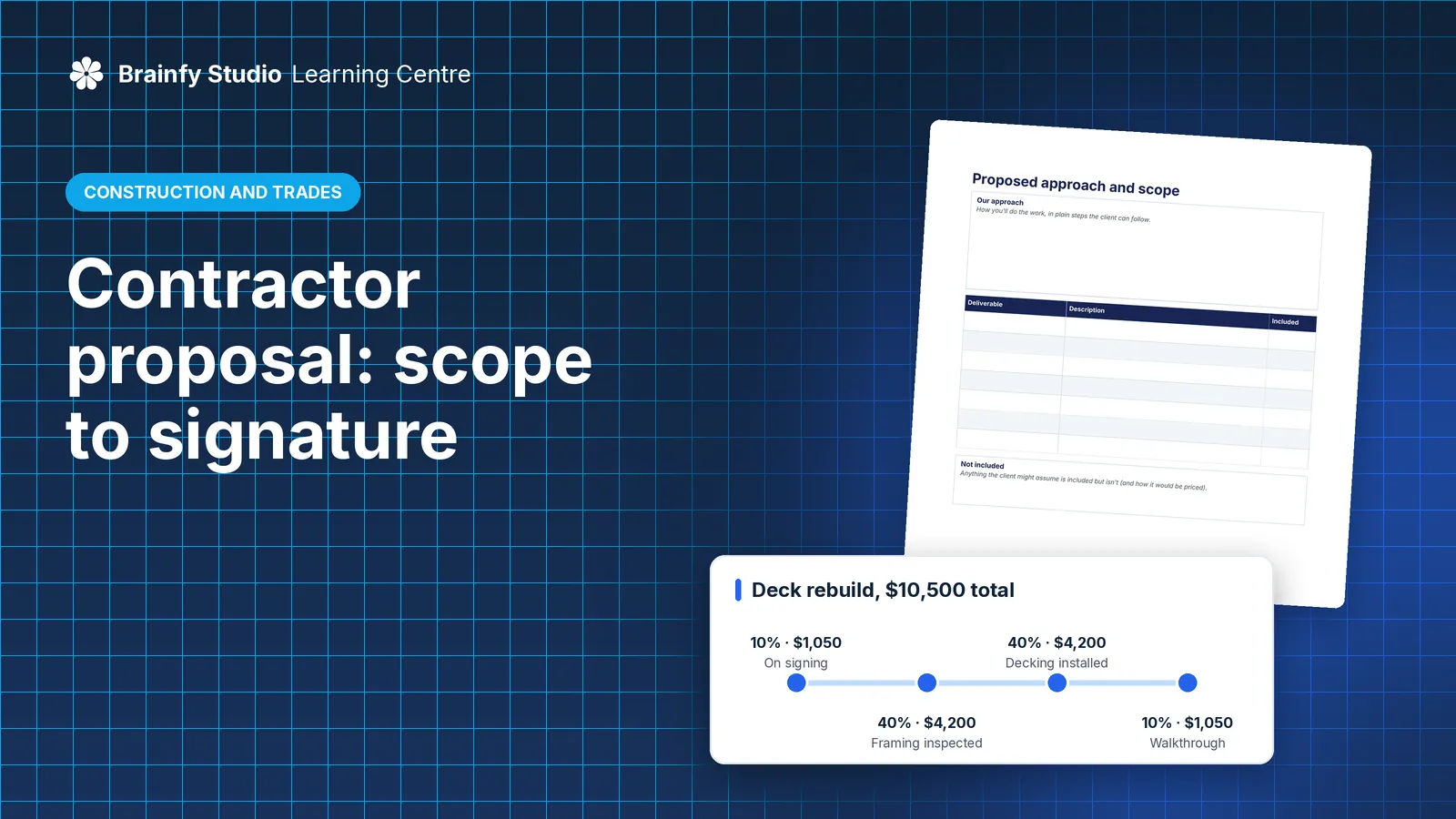
The same proposal ties each payment to a stage of the work a client can see, so nobody pays far ahead of the work and the contractor is not carrying the whole job on credit.
| Payment | When it is due | Share | Amount |
|---|---|---|---|
| Deposit | On signing | 10% | $1,050.00 |
| Progress payment 1 | Framing passes inspection | 40% | $4,200.00 |
| Progress payment 2 | Decking and railing installed | 40% | $4,200.00 |
| Final payment | Completion walkthrough signed off | 10% | $1,050.00 |
| Total | 100% | $10,500.00 |
Timeline: work starts within 10 working days of the permit being issued and takes 6 working days on site (demolition and footings on days 1 and 2, framing and inspection on day 3, decking on days 4 and 5, railing and stairs on day 6), weather permitting.
Allowances: if the client's chosen lights cost $520.00 instead of the $400.00 allowance, the $120.00 difference is added by a signed change order; if they cost less, the difference is credited. The permit is billed at its actual cost.
Acceptance: the price is valid for 30 days. Below the terms are signature and date lines for the client and the contractor. Some provinces and states set rules for home-improvement contracts, such as deposit limits or cancellation periods, so check the rules where the job is.
How is a proposal different from an estimate or a quote?
An estimate is your own cost build-up: quantities, unit costs, labour hours, overhead, contingency and markup. A quote is a fixed price for a defined job. A proposal is what the client accepts: it presents the price together with the scope, exclusions, payments, timeline and terms. Most contractors build the estimate first and write the proposal from it, showing selling prices rather than their costs and markup.
Related: Invoice vs quote: what each one is for · Markup vs margin for contractors
How do you write the scope and exclusions?
Write the scope as a list of things the client could check on site: what is removed, what is built, with what material, in what quantity. Avoid words like "standard" or "as needed" without a definition. For each line, ask what the client might reasonably assume is included and is not, and put that in the exclusions.
Common exclusions on small residential jobs are permits the client is arranging, repairs to hidden damage, electrical or plumbing work by others, moving furniture or appliances, and finishing work such as painting or landscaping.
How do allowances and change orders work in a proposal?
An allowance is a placeholder amount for something the client will choose later. State the amount, what it covers (supply only, or supply and install) and that the difference is added or credited once the choice is made. A change-order clause says that any change to the scope is priced and signed before the extra work starts, so the proposal total and the final invoice can always be reconciled.
Related: How to write a construction change order · Pricing allowances and contingency in a remodel estimate
Is there a free contractor proposal template?
Brainfy Studio does not have a free downloadable proposal template. The free part is the online Construction Estimate Calculator, which prices the cost lines a proposal is built from, and the worked example on this page, which you can copy into any document. The proposal files listed below are paid.
Which Brainfy files make a proposal?
The Contractor Professional Estimating System turns an estimate into a printable Proposal sheet. The Business Proposal Kit is a Word proposal template with a payment schedule and signature blocks. The Project Proposal Template Pack includes a one-page proposal for small jobs and a pricing worksheet, in Word and PDF. The Quote to Invoice Tracker with Deposit Schedule prints a quote with deposit, progress and final payments and then tracks what each job still owes. All are paid; the spreadsheets are tested in LibreOffice Calc only.
Related: Contractor Professional Estimating System · Business Proposal Kit · Project Proposal Template Pack · Quote to Invoice Tracker with Deposit Schedule
Before you send a proposal
- Every scope line has a quantity and a unit, and the amounts add up to the subtotal.
- Exclusions are listed, including hidden damage and work by others.
- Each allowance states its amount and what happens if the choice costs more or less.
- Payments are tied to stages of the work and add up to 100% of the total.
- Tax is shown separately at the rate that applies to this job.
- The timeline says what the dates depend on.
- The change-order clause and the validity period are written in.
- There are signature and date lines for both parties.
Brainfy files for this task
Checked against the files customers download. Prices are current catalogue prices.
Contractor Professional Estimating System
Builds the proposal from the estimate: the Proposal sheet is a printable client summary with scope and exclusions, filled from the Estimate sheet and your Company settings. Paid. The .xlsx is tested in LibreOffice Calc only.
A 6-page Word proposal template with scope and deliverables, exclusions, a timeline, an investment table, a payment schedule, terms and client and business acceptance signatures, plus a 3-page writing guide. Paid. Rendered in LibreOffice Writer; not opened in Microsoft Word, Google Docs or Apple Pages.
The change order request, the priced change order with signature blocks, a change order log and a time-and-materials record, for the change-order clause your proposal refers to. Paid.
Questions
Should a proposal show my markup?
Usually not. A proposal shows selling prices per line or per stage. Keep the cost build-up, overhead and markup in your own estimate, so you can explain the price without sharing your costs.
How long should a proposal be valid?
Long enough for the client to decide, short enough that material prices have not moved: 30 days is common for small jobs. Write the validity period next to the signature lines.
Is a signed proposal the same as a contract?
An accepted proposal can form part of your agreement with the client. Use it with your own terms or contract, and check the rules for home-improvement contracts where you work. This guide is general information, not legal advice.
Which apps open the proposal files?
The Word files were rendered in LibreOffice Writer and not opened in Microsoft Word, Google Docs or Apple Pages. The spreadsheets were recalculated in LibreOffice Calc with no formula errors; Microsoft Excel, Google Sheets and Apple Numbers were not tested.
Sources and method
The deck job is invented and its prices are illustrations, not regional prices. Every line amount, the subtotal, the tax, the total and each payment are recomputed by an automated test. Product facts were read from each product's live page on November 19, 2026.